Leetcode Problem Solve - Valid Palindrome
Headings
Today, let’s dive into another popular problem from Leetcode, the “Valid Palindrome” problem. This problem is fundamental for understanding string manipulation and the two-pointer technique.
Introduction
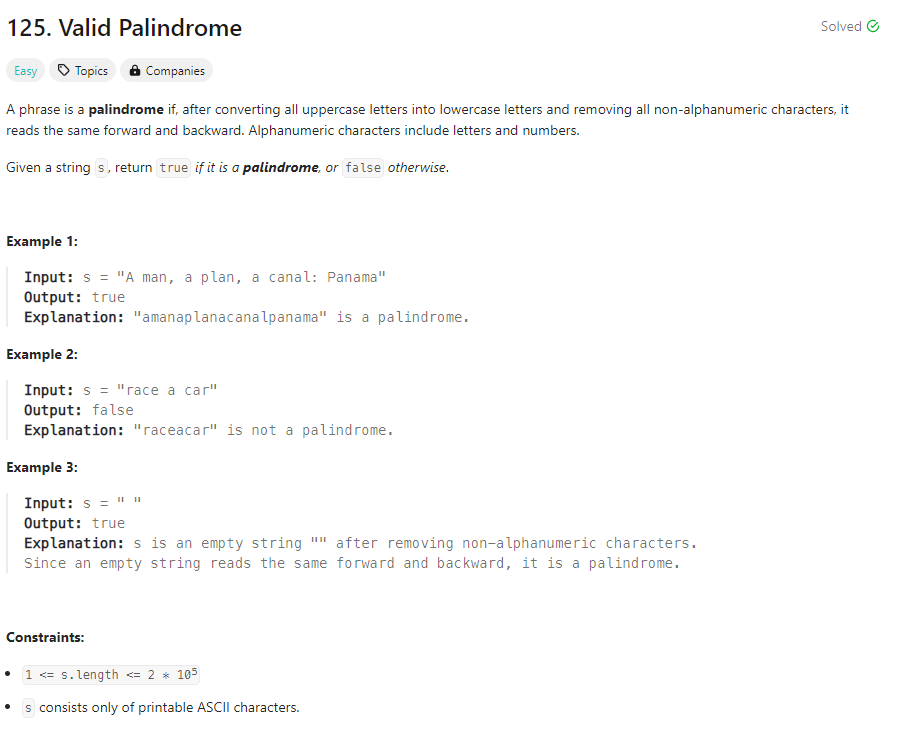 Valid Palindrome Problem Description
1
2
3
Given a string s, determine if it is a palindrome, considering only alphanumeric characters and ignoring cases.

For example, "A man, a plan, a canal: Panama" is a palindrome, while "race a car" is not.
The “Valid Palindrome” problem helps us understand how to handle strings efficiently and utilize two-pointer techniques for palindrome checking.
Analysis
To solve this problem, we need to normalize the string by removing all non-alphanumeric characters and converting it to lowercase. Then, we can use a two-pointer approach to check if the string reads the same forwards and backwards.
Solutions
1. Using Regular Expressions
1
2
3
4
5
6
7
8
9
10
11
12
13
14
15
16
17
18
import re

class Solution:
    def isPalindrome(self, s: str) -> bool:
        # Normalize: remove non-alphanumeric characters and convert to lowercase
        nS = re.sub('[^a-zA-Z0-9]', '', s).lower()
        i = 0
        j = len(nS) - 1

        while i < j:
            # If characters don't match, it's not a palindrome
            if nS[i] != nS[j]:
                return False

            i += 1
            j -= 1

        return True
In this approach, we use the re module to remove all non-alphanumeric characters and convert the string to lowercase. We then use a two-pointer technique to check if the string is a palindrome.
Time Complexity: O(N) - We iterate through the string twice (once for normalization and once for the palindrome check).
Space Complexity: O(N) - We store the normalized string.
2. Using String Methods
1
2
3
4
5
6
7
8
9
10
11
12
13
14
15
class Solution:
    def isPalindrome(self, s: str) -> bool:
        # Normalize: remove non-alphanumeric characters and convert to lowercase
        nS = ''.join(char.lower() for char in s if char.isalnum())

        # Two-pointer technique to check palindrome
        i, j = 0, len(nS) - 1

        while i < j:
            if nS[i] != nS[j]:
                return False
            i += 1
            j -= 1

        return True
This approach uses string methods to filter out non-alphanumeric characters and convert the string to lowercase. It then applies the two-pointer technique to check for a palindrome.
Time Complexity: O(N) - We iterate through the string twice (once for normalization and once for the palindrome check).
Space Complexity: O(N) - We store the normalized string.
Conclusion
In this post, we explored two different approaches to solve the “Valid Palindrome” problem. The first approach used regular expressions for normalization, while the second approach utilized string methods. Both approaches efficiently check for palindromes and meet the problem’s requirements.
If you have any questions or suggestions, please feel free to leave a comment below.
Thank you for reading!