Leetcode Problem Solve - Remove Element
Headings
After diving into the Two Sum problem, today let’s explore another classic problem from Leetcode, the “Remove Element” problem. This problem is straightforward but can be solved using different approaches, each with its own trade-offs.
Introduction
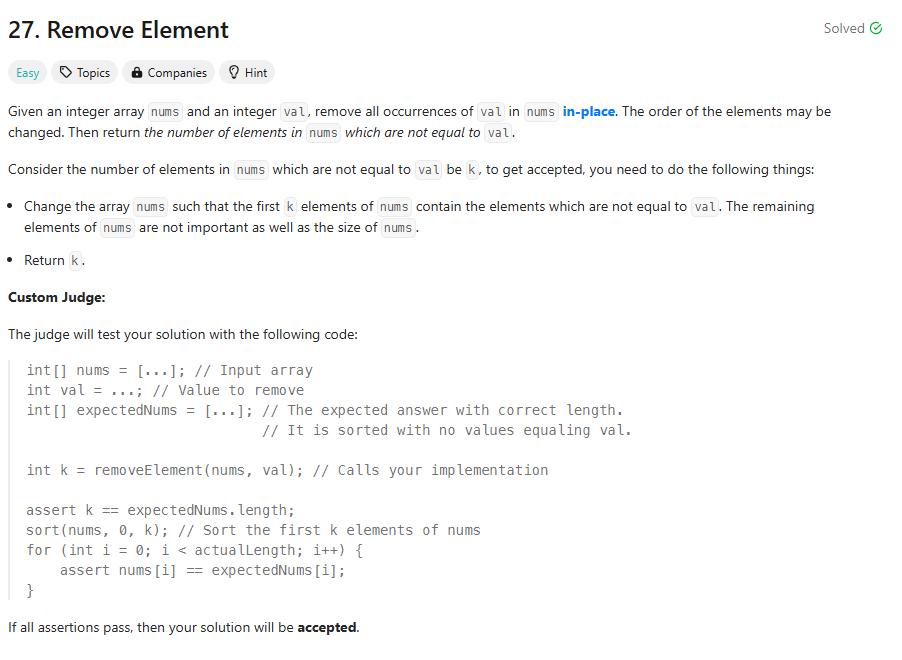 Remove Element Problem Description
1
2
3
4
5
6
Given an integer array nums and an integer val, remove all occurrences of val in nums in-place. The order of the elements may be changed. Then return the number of elements in nums which are not equal to val.

Consider the number of elements in nums which are not equal to val be k, to get accepted, you need to do the following things:

* Change the array nums such that the first k elements of nums contain the elements which are not equal to val. The remaining elements of nums are not important as well as the size of nums.
* Return k.
The Remove Element problem is a fundamental problem that helps understand the concepts of in-place array manipulation and efficient space usage.
Analysis
We need to remove all occurrences of a specific value from the array and return the new length of the array. Importantly, we need to do this in-place with O(1) extra memory, meaning we can’t use additional arrays or significant extra space.
Solutions
1. Simple List Comprehension
1
2
3
4
5
6
7
8
9
10
class Solution:
    def removeElement(self, nums: List[int], val: int) -> int:
        newArr = []

        for x in nums:
            if x != val:
                newArr.append(x)

        nums[:] = newArr
        return len(nums)
In this approach, we create a new array newArr and append all elements from nums that are not equal to val. After that, we copy newArr back to nums and return its length.
However, this solution uses extra space proportional to the number of elements in nums, which does not meet the problem’s constraint of using O(1) extra memory.
Time Complexity: O(N)
Space Complexity: O(N) - due to the additional array newArr.
2. Two-Pointer Approach
1
2
3
4
5
6
7
8
9
10
11
12
13
class Solution:
    def removeElement(self, nums: List[int], val: int) -> int:
        pOne = 0
        pTwo = len(nums) - 1

        while pOne <= pTwo:
            if nums[pOne] == val:
                nums[pOne], nums[pTwo] = nums[pTwo], nums[pOne]
                pTwo -= 1
            else:
                pOne += 1

        return pTwo + 1
This approach utilizes a two-pointer technique to solve the problem in-place. We initialize two pointers: pOne at the start and pTwo at the end of the array. The idea is to swap elements when nums[pOne] is equal to val and adjust the pointers accordingly.
- If
nums[pTwo]equalsval, we decrementpTwo. - If
nums[pOne]equalsval, we swap it withnums[pTwo]and decrementpTwo. - In both cases, we increment
pOneto continue the check.
This method ensures we only use O(1) extra space.
Time Complexity: O(N)
Space Complexity: O(1)
Conclusion
In this post, we explored two different approaches to solve the Remove Element problem. The first approach was straightforward but did not meet the space complexity constraint. The second approach, using a two-pointer technique, was more efficient and met all the problem requirements.
If you have any questions or suggestions, please feel free to leave a comment below.
Thank you for reading!